


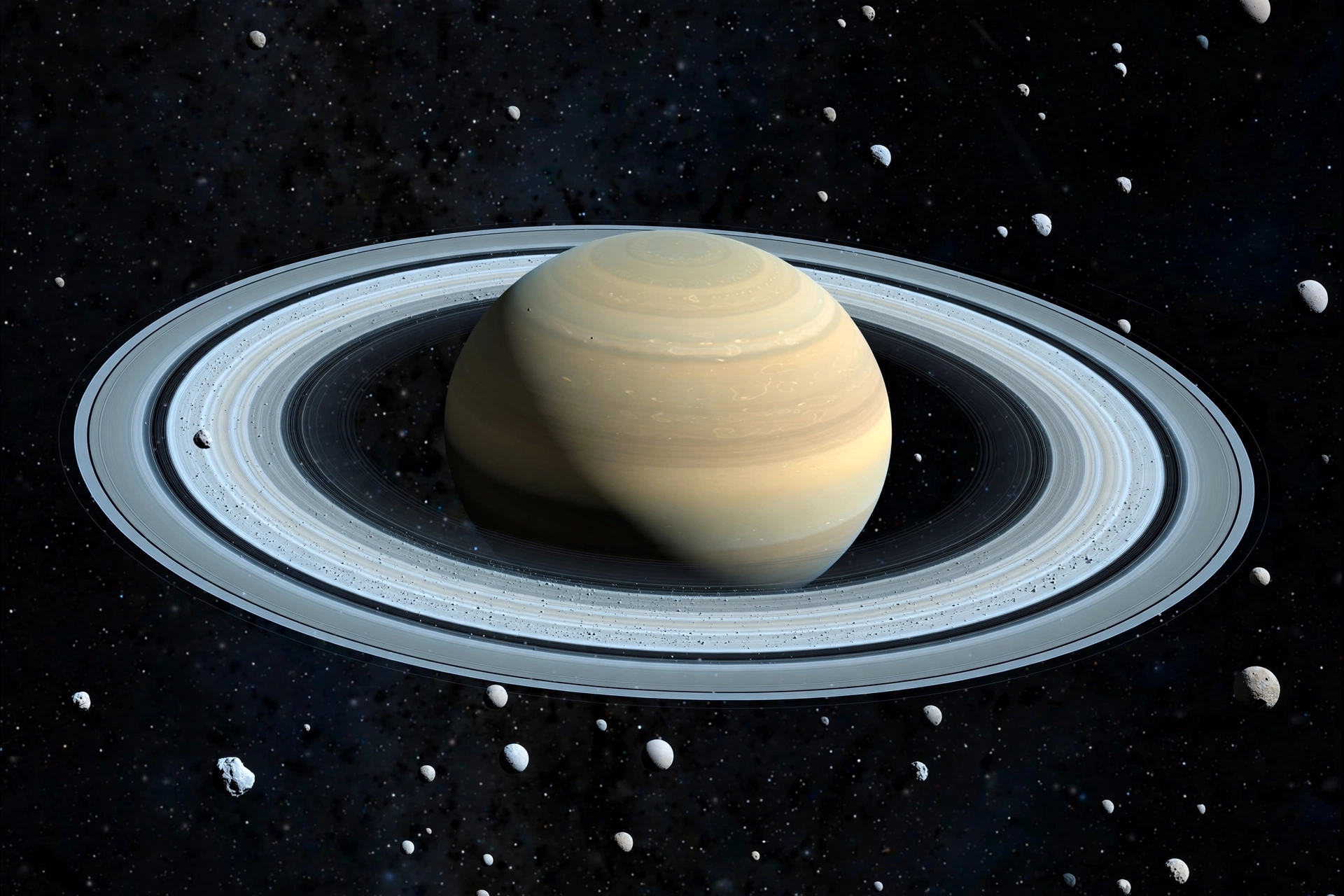
Saturn has tightened its grip on one of the solar system’s most charming records. Astronomers have confirmed 128 new moons in orbit around the ringed planet, taking its official total to 274 — comfortably the largest family of moons known around any planet, and nearly double the tally of its nearest rival, Jupiter.
The newcomers are not grand worlds like Titan or Enceladus. Most are irregular moons just a few kilometres across: dark, lopsided fragments of rock and ice tumbling around Saturn on tilted, elongated orbits, some of them circling the planet backwards. What they lack in size, they make up for in what they can tell scientists about the violent early history of the outer solar system.
How the new moons were found
The discoveries come from a patient survey carried out with the Canada-France-Hawaii Telescope on Mauna Kea, where astronomers took repeated long-exposure images of the sky around Saturn and stacked them together. Faint objects that moved with the planet, frame by frame, revealed themselves as candidate moons, while background stars stayed fixed.
Finding candidates is only half the work. Each object then has to be tracked for months, sometimes years, until its orbit is known precisely enough for the International Astronomical Union to recognise it as a genuine moon. That formal recognition has now been granted to all 128, according to researchers at the University of British Columbia, whose team led the analysis of the survey data.
It is painstaking astronomy, closer to detective work than to the popular image of gazing through a telescope. As our readers saw with a recent dawn launch that lit up the East Coast sky, the most rewarding spectacles in the sky often reward those willing to look carefully and wait.
Why so many tiny moons matter
Irregular moons are thought to be captured objects: asteroids and Kuiper belt fragments that wandered too close to a giant planet billions of years ago and never escaped. Many of Saturn’s small moons travel in loose groups that share similar orbits, which suggests each group is the debris of a single larger body that broke apart in a collision.
By mapping those families, astronomers can work backwards to reconstruct impacts that happened long before any telescope existed. The new haul roughly doubles the number of known members in some groups, giving researchers a far richer sample to test their models of how the outer planets formed and migrated.
A record that keeps growing
Saturn and Jupiter have traded the moon crown several times in the past decade as surveys improved. Jupiter currently stands at 274 minus a considerable margin — 95 recognised moons — and each new deep survey of Saturn seems to widen the gap. Astronomers caution that the race is really about telescope sensitivity: both planets almost certainly host thousands of kilometre-sized objects that remain below the limit of detection.
Future instruments, including the Vera C. Rubin Observatory, are expected to push that limit fainter still. When they do, Saturn’s total could climb again — and the humble, rubble-like moons confirmed this week will be remembered as the finds that made 274 the number to beat.
What the moons are made of
Although none of the new moons has been visited by a spacecraft, astronomers can infer a good deal from their brightness, colour and orbits. Irregular moons are typically dark, reddish objects, consistent with a mixture of water ice, rock and carbon-rich material similar to the asteroids of the outer belt and the smaller bodies of the Kuiper belt. Their surfaces have been darkened by billions of years of radiation and micrometeorite impacts.
Their orbits tell an equally rich story. Many of the newcomers belong to the Norse group, a swarm of moons that circle Saturn in the opposite direction to the planet’s spin, spread across a wide range of distances and inclinations. A smaller number join the Inuit and Gallic groups, which move in the same direction as Saturn’s rotation. Group membership is the primary clue astronomers use when they argue that dozens of today’s moons began as a handful of much larger bodies.
There is also a practical dimension to the catalogue. Mission planners designing future journeys to the Saturn system — and concepts for follow-up visits to Titan and Enceladus are regularly discussed — rely on accurate maps of everything in orbit, however small. A complete census makes navigation safer and helps scientists choose targets that a passing spacecraft might photograph on its way through the system.
