


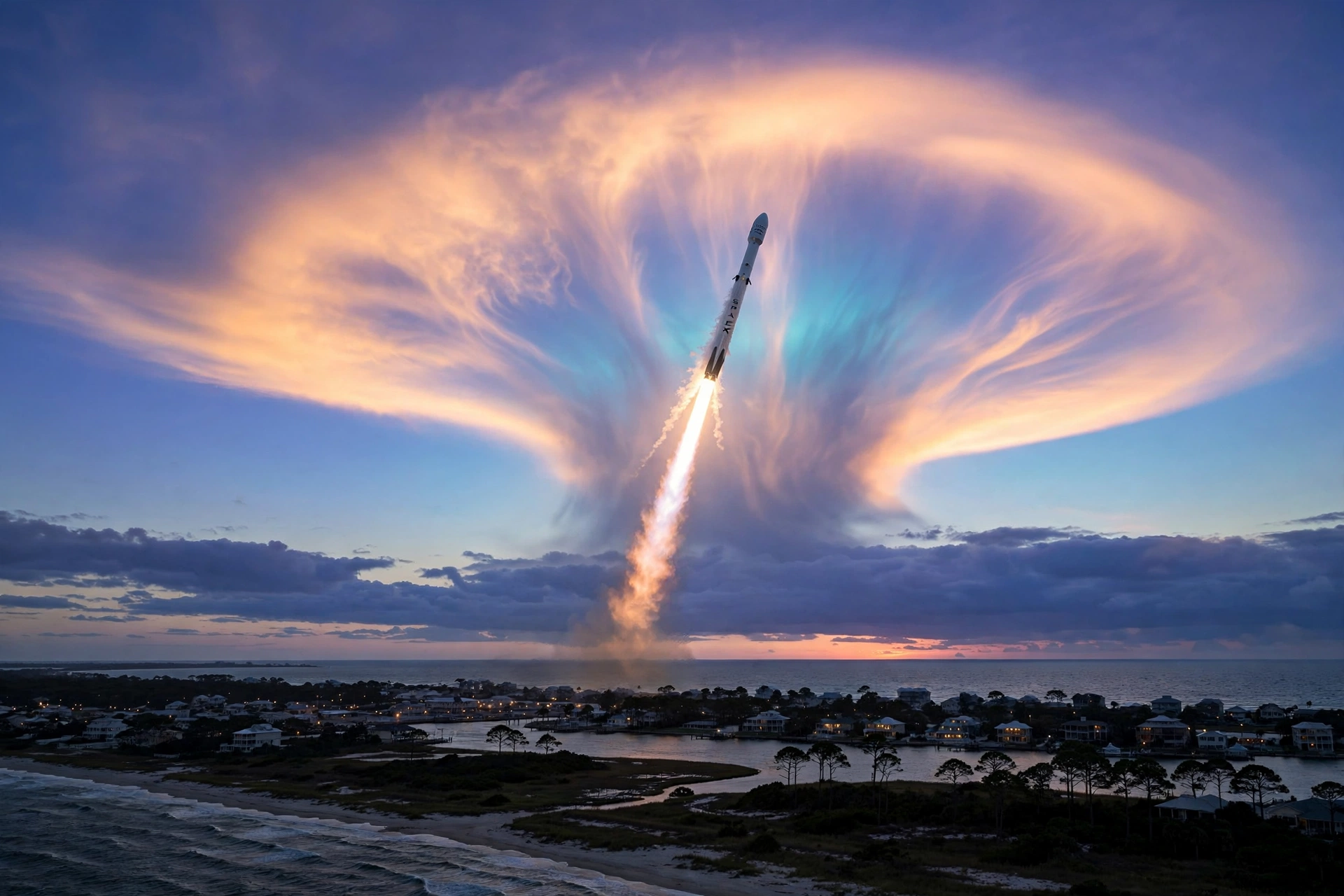
Early risers along the US east coast were treated to an unusual sight this week: a glowing, expanding cloud that looked uncannily like a giant jellyfish drifting across the dawn sky. The cause was not a weather anomaly or anything mysterious. It was a SpaceX rocket launch, timed so that its exhaust plume caught the sunlight while the ground below was still in twilight.
Photographs and videos shared widely online showed a bright core with a translucent, billowing halo spreading above it — the classic shape space fans call a “space jellyfish.” Reports of the sighting, covered by The Guardian, described a stunning cloud visible off the east coast as the rocket climbed.
Why a Rocket Can Look Like a Jellyfish
The effect is a trick of timing and altitude. Launches that take place shortly before sunrise or just after sunset can produce it when the rocket rises high enough for its exhaust to be lit by the sun, even though observers on the ground are still in relative darkness. The contrast makes the plume appear to glow against the dim sky.
As the rocket gains altitude, the surrounding air pressure drops. Exhaust gases that leave the nozzle in a tight stream at sea level can expand much more widely in the thin upper atmosphere, spreading into a broad, rounded fan. That expanding, sunlit fan forms the bell of the jellyfish, while the brighter exhaust trail beneath it can resemble trailing tentacles.
Why This Sighting Drew So Much Attention
Several ingredients came together. The launch happened at a time of day when many people were awake and outdoors or commuting. The sky conditions allowed the plume to be seen over a wide area rather than being hidden by cloud. And the shape itself is striking enough that people who had never heard the term “space jellyfish” stopped to photograph it and ask what it was.
That public curiosity is valuable. Each widely shared sighting sends new readers looking for explanations of orbital mechanics, launch windows and atmospheric physics — a reminder that routine cargo and satellite missions can still produce moments of genuine wonder. For more on how everyday stories capture readers, see our report on the quiet comeback of local news and community journalism.
Not Every Launch Produces One
Jellyfish displays depend on a narrow set of conditions. A midday launch will not show the same contrast, because the whole sky is bright. A launch deep in the night may leave the plume unlit. Cloud cover at ground level can hide the view entirely, and the angle of the trajectory relative to the coast determines how many people are in a good position to see it.
When the conditions do align, the display usually lasts only a few minutes as the plume disperses, which adds to the sense of luck among those who happen to look up at the right moment.
How to Catch the Next One
Space enthusiasts suggest checking launch schedules from Florida’s space coast, favouring liftoffs scheduled in the hour before sunrise or after sunset, and finding a viewing spot with a clear, dark horizon facing the launch direction. Official mission information is published by SpaceX ahead of each flight, including webcast timings that help viewers step outside at the right minute.
Photographers along the coast said the colours shifted from white to soft gold as the plume expanded and the sun rose higher in the sky.
Binoculars are not required — the jellyfish effect is a large-scale sky phenomenon best appreciated with the naked eye — but a phone camera on night mode can capture the colours surprisingly well.
The Bottom Line
The jellyfish cloud was a brief, beautiful side effect of a working rocket doing an ordinary job at an extraordinary hour. Sunlight, thin air and expanding exhaust did the rest. As launch cadence from the east coast continues to grow, dawn and dusk liftoffs will keep giving coastal residents occasional chances to see one of the strangest and prettiest sights in the modern sky.
