


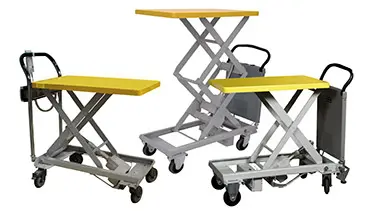
Across Canadian warehouses, manufacturing facilities, and distribution centers, manual lifting of heavy loads remains a primary cause of workplace injuries. Employees who repeatedly bend, lift, and carry items from ground level to workbench height face cumulative strain on their backs, shoulders, and knees. A mobile scissor lift table provides height-adjustable work positioning that reduces physical strain during repetitive material handling tasks. In industrial and commercial settings, these devices support ergonomic work practices and improve operational efficiency.
Canadian occupational health and safety regulations increasingly emphasize ergonomic risk reduction. Facilities that implement height-adjustable workstations demonstrate compliance with workplace safety standards while reducing injury-related absenteeism. The mobile design allows a single lift table to serve multiple workstations throughout a facility, maximizing equipment utilization.
Common Applications and Operational Methods
A mobile scissor lift table is commonly used for:
- Positioning heavy components at assembly height
- Lifting pallets to ergonomic working levels
- Feeding materials into processing equipment
- Stacking finished goods for storage
- Transporting loads between workstations
The scissor mechanism uses linked folding supports that extend vertically when hydraulic pressure is applied. Foot pedal operation allows hands-free height adjustment, keeping both hands available for load control. The rubber-padded tabletop prevents load shifting during lifting and provides non-slip surface contact. Mobile casters enable single-operator repositioning between tasks.
Ergonomics and Workplace Productivity
Working at improper heights forces employees into awkward postures that accelerate fatigue. When a worker must repeatedly bend to floor level or reach above shoulder height, energy expenditure increases while precision decreases. Adjustable-height work positioning keeps materials within the optimal lifting zone, approximately waist height, where the body generates maximum force with minimum strain.
Productivity improves when lift tables reduce unnecessary motion. A worker loading heavy boxes onto a conveyor spends less energy on each lift, maintaining consistent output throughout the shift. Facilities that implement height-adjustable workstations often report increased throughput and reduced break frequency due to lower physical fatigue.
Technical Principles and Capacity Considerations
Scissor lift tables operate on hydraulic principles. A hydraulic cylinder extends as the operator activates the foot pump, pushing the scissor arms apart and raising the tabletop. Lowering occurs through controlled release of hydraulic pressure, allowing gravity to lower the platform gradually. This design provides smooth, predictable vertical movement without sudden drops.
Capacity ratings indicate the maximum load the lift table can safely raise. Distributing weight evenly across the tabletop is essential for stable operation. Uneven loads can cause binding in the scissor mechanism or tip the lift table during elevation. Operators should position the heaviest items near the center of the platform.
Factors Affecting Performance and Safety
Several conditions influence how a mobile scissor lift table performs in daily use:
- Floor surface condition and levelness
- Wheel caster quality and maintenance
- Hydraulic fluid temperature and level
- Load distribution across the tabletop
- Frequency of lifting cycles
Performance and safety are influenced by several factors. Floor surface irregularities can make it difficult to roll the lift table when loaded. Caster wheels accumulate debris that reduces mobility and stability. Hydraulic fluid thickens in cold temperatures, slowing lift speed during winter months in unheated warehouses.
Operators should inspect wheel casters, hydraulic connections, and platform condition regularly. Fluid leaks and worn wheel bearings can affect long-term equipment reliability if maintenance is neglected.
Safety Guidelines and Operational Best Practices
Safe operation of a mobile scissor lift table requires attention to several key practices:
- Center the load on the tabletop before lifting
- Keep feet clear of the scissor mechanism during lowering
- Lock casters before elevating to prevent rolling
- Never exceed the rated load capacity
- Lower platform fully before moving the unit
Operators should also avoid standing on the lift table unless it is specifically designed for personnel lifting. Standard material lift tables lack guardrails and fall protection required for elevated work positions. Using a lift table as a personnel lift creates serious fall hazards.
Equipment Types and Supporting Accessories
Mobile scissor lift tables are available in various capacities and platform sizes. Capacities typically range from several hundred pounds to several tons. Platform dimensions should match the largest items handled routinely. Smaller platforms are more maneuverable but may require multiple repositionings for oversized loads.
Supporting accessories include turntable tops for rotating loads, roller tops for sliding materials, and scale integration for weighing items during lifting. Non-marking casters protect sensitive flooring while maintaining mobility. Foot pedal extensions allow operation from the side of the lift table when loading from the front is not feasible.
Advantages and Limitations
Advantages of a mobile scissor lift table include:
- Reduced employee lifting strain and injury risk
- Increased productivity through faster load positioning
- Mobility for use across multiple workstations
- Consistent work height for quality control
- Lower fatigue levels during extended shifts
Limitations to consider:
- Floor space required for maneuvering
- Regular hydraulic system maintenance
- Cold weather affecting lift speed
- Not suitable for personnel lifting without modifications
- Initial investment cost for quality units
Real-World Application Examples
A Canadian automotive parts warehouse in Ontario processed thousands of heavy components daily. Workers lifted transmission cases from pallets onto inspection tables. After implementing mobile scissor lift tables, workers positioned pallets at waist height, eliminating bending. Injury claims related to back strain dropped by sixty percent. Productivity increased as each lift cycle was reduced from ten seconds to three seconds.
In another application, a furniture manufacturer used lift tables to feed plywood sheets into a CNC router. The lift table positioned the sheet stack at the optimal feed height, allowing the operator to slide sheets onto the router bed without lifting. This reduced material waste caused by dropped sheets and improved operator morale.
Future Trends in Material Handling Equipment
The material handling industry continues to develop lift table technology. Battery-powered lift tables eliminate the need for foot pedal pumping, reducing operator effort. Integrated scales allow weighing during lifting, combining two operations into one. Smart sensors can monitor lift cycles and alert maintenance staff when hydraulic service is due.
As Canadian workplaces continue prioritizing ergonomic safety, demand for height-adjustable material handling equipment will likely grow. Facilities that invest in scissor lift tables demonstrate commitment to worker well-being while gaining productivity advantages over competitors using manual lifting methods.
mobile scissor lift table, hydraulic lift cart, ergonomic material handling equipment
