


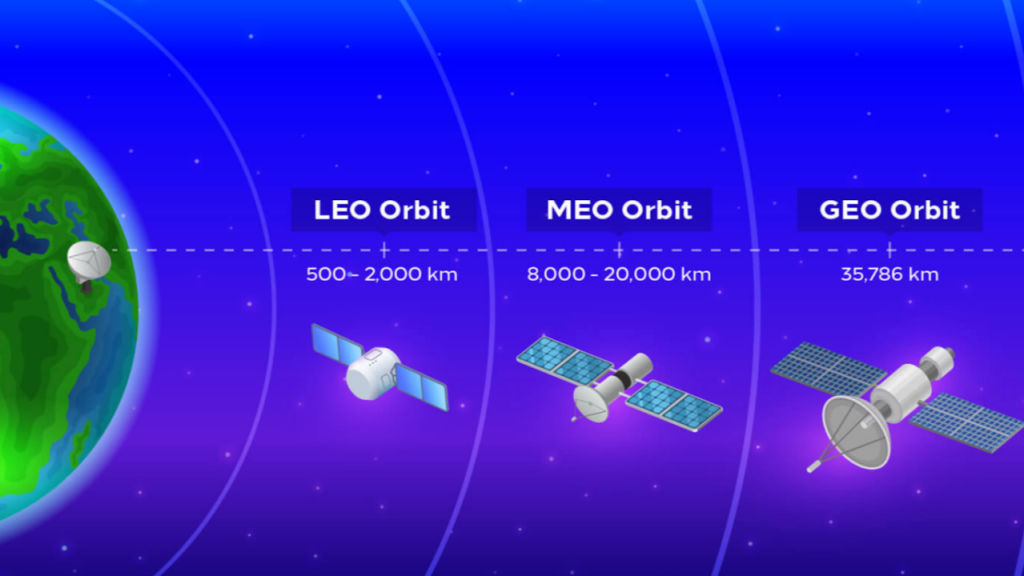
The era of relying on a single network to power connectivity for a business is gone. The rising demand for always-on connectivity calls for new strategies, such as a Multi-orbit connectivity. The modern approach brings together different satellite technologies (Low Earth Orbit (LEO), Geostationary Orbit (GEO), and often L-band) into a single communications environment. Instead of just depending on one network, organisations use multiple layers simultaneously to maintain performance and reliability.
In a multi-orbit setup, each orbit serves a different purpose:
- LEO connectivity delivers high speeds and low latency, which supports modern digital applications
- GEO satellites provide wide regional coverage with consistent availability
- L-band offers highly dependable, weather-resistant links for backup communications
With the help of the right management tools, traffic can move between these networks automatically. If one connection weakens, another takes over. The result is a more resilient, “always-on” communications setup.
Industry momentum is showing this shift. According to recent statistics, the combined LEO and GEO satellite internet market is expected to grow from $14.56 billion in 2025 to $33.44 billion by 2030, with annual growth above 18%. That growth is being driven largely by enterprise demand for more reliable connectivity across challenging environments.
Why Businesses Are Moving Towards Multi-Orbit Connectivity?
Moving towards multi-orbit strategies is not just hopping onto a trend bandwagon. It is now necessary for seamless business operations. Let’s ponder over why businesses are adopting this approach fast:
Downtime Is Becoming Unacceptable
Many organisations now rely on continuous connectivity to function. A network interruption can delay production, halt logistics, or disrupt safety systems.
Especially, sectors such as energy, maritime, aviation, and mining operate in locations where communications failures literally mean financial loss. Introducing redundancy through multiple satellite layers reduces exposure to these risks.
Remote Operations Are Expanding Globally
Industrial activity continues to push further into areas where terrestrial infrastructure is limited, unreliable, or even absent.
Typical examples include:
- Offshore energy installations
- Maritime fleets operating across long routes
- Remote mining and resource projects
- Infrastructure development in emerging markets
- Government deployments in isolated regions
For these environments, satellite connectivity from multiple orbits becomes the primary communications backbone rather than a secondary option.
Rapid Growth of LEO Infrastructure
The expansion of LEO constellations has completely changed what satellite networks can deliver. Latency levels in the region of 20–50 milliseconds now support cloud platforms, video collaboration, and real-time monitoring in ways that were previously difficult with traditional satellite systems alone.
Business show keen interest in LEO connectivity solutions such as Starlink for enterprise because they provide high-bandwidth connectivity in locations where fibre or mobile coverage may never reach.
For land-based remote operations, Starlink Land is increasingly used across industrial sites, construction projects, and temporary facilities where rapid deployment is needed.
Rising Data Demands from Digital Operations
Organisations are collecting and processing far more data than before.
IoT devices, automation platforms, predictive maintenance tools, and AI-driven analytics all depend on stable connectivity. Multi-orbit connectivity infrastructure allow traffic to be prioritised intelligently. High-bandwidth workloads can use LEO and GEO, while essential communications remain protected through backup layers.
Resilience Is Now a Strategic Priority
External risks are also influencing connectivity decisions. Cyber threats, extreme weather events, infrastructure outages, and geopolitical uncertainty are prompting organisations to rethink network resilience for business continuity.
Enterprises now want independence from any single network or provider. Multi-orbit architecture directly supports this objective by introducing diversity into communications pathways.
How Multi-Orbit Connectivity Works in Practice
In real deployments, multi-orbit connectivity relies on an advance network management system that manages multiple links simultaneously.
A typical configuration involves:
- LEO acting as the primary high-performance connection
- GEO supporting regional coverage or load balancing
- L-band maintains essential communications during disruption
Automatic failover ensures continuity without manual intervention. Modern systems monitor latency, bandwidth usage, and signal quality continuously, and select the most appropriate connection based on application needs and network conditions.
Benefits for Global Businesses
The advantages of multi-orbit connectivity are:
Continuous Operations
Having multiple communication paths reduces the possibility of outages. This matters most in environments where downtime can result in significant operational or financial consequences.
Higher Performance
Organisations can align connectivity performance with application requirements, improving efficiency and user experience across sites.
Global Reach Without Infrastructure Dependence
Connectivity becomes possible across oceans, deserts, mountainous terrain, and remote territories without relying on local telecom infrastructure.
Flexibility Across Use Cases
Multi-orbit solutions adapt to a wide range of environments, including offshore platforms, maritime fleets, remote industrial operations, government projects, emergency response deployments, or emporary construction sites.
For shipping and offshore operations, solutions like Starlink Maritime are being integrated into multi-orbit architectures to maintain connectivity across long routes and changing conditions.
Stronger Risk Management
Redundant communications layers strengthen disaster recovery strategies and improve overall operational resilience.
Industries Benefiting Most from Multi-Orbit
Adoption of multi-orbit or hybrid connectivity is progressing quickly across several sectors.
- Maritime and Offshore Energy: Vessels and offshore installations require reliable communications across long distances and changing environmental conditions. Hybrid connectivity also plays an important role in supporting GMDSS compliance and maintaining essential communications during severe weather or network degradation.
- Government and Defence: Secure, continuous connectivity is essential for national infrastructure and mission-critical operations.
- Mining and Remote Industry: Operations often depend entirely on satellite communications due to the lack of terrestrial coverage.
- Construction and Infrastructure: Projects benefit from rapid deployment and scalable bandwidth during development phases.
- Humanitarian and Emergency Response: Reliable communications are important for rescue operations when ground networks are damaged or unavailable.
Managed Connectivity Providers Enabling Multi-Orbit Connectivity
Designing and deploying multi-orbit environments involves integration, optimisation, and ongoing management. Many organisations rely on specialised providers to handle this complexity.
Companies such as IEC Telecom, a global Satcom service provider and an authorised reseller for Starlink solutions, typically support implementation and integration of multi-orbit systems so organisations can concentrate on their core operations rather than network management.
Looking Ahead: Multi-Orbit Becoming Standard Infrastructure
The direction of travel across the industry is clear. As continuous connectivity becomes a fundamental need rather than a supporting utility, multi-orbit strategies are increasingly forming the foundation for always-on global operations.
Key developments likely to shape the next phase include:
- Continued expansion of LEO constellations
- Greater integration between satellite and terrestrial networks
- More intelligent traffic routing and automation
- Increased enterprise demand for resilient communications
- Growth in remote and autonomous operations
As digital transformation continues to accelerate, organisations need connectivity that works reliably regardless of location.
