


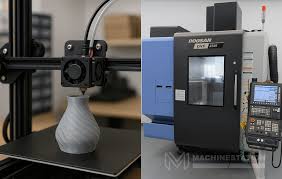
Two Methods, Fundamentally Different Outputs
The 3D printing vs CNC machining debate is not a competition — it is a selection problem. Each method produces a fundamentally different type of prototype with different performance characteristics, cost structures, and lead times. Choosing the wrong method for a given development stage wastes both time and money. Choosing the right one accelerates product development and reduces downstream risk.
The global rapid prototyping market reached $4.3 billion in 2023 (MarketsandMarkets). Within it, CNC machining dominates functional metal prototype production (58% market share) while polymer 3D printing dominates visual and fit-check models (71% of non-metallic prototypes). These market shares exist because each method wins at what it is designed for.
| Comparison Factor | 3D Printing (FDM/SLA/SLS) | CNC Machining |
| Material properties | Printed anisotropic properties; weaker in Z-axis by 20-40% | Isotropic, identical to production material |
| Dimensional accuracy | ±0.1-0.5 mm typical | ±0.025 mm standard; ±0.005 mm achievable |
| Surface finish | Visible layer lines; Ra 3-12 µm typical | Ra 0.4-3.2 µm standard; 0.1 µm achievable |
| Speed (single part) | 1-24 hours for most parts | 1-5 days including setup and inspection |
| Unit cost (complex part) | $20-$200 typical | $150-$2,500 depending on complexity |
| Functional testing suitability | Limited — material properties not representative | Full — production-equivalent material performance |
| Design freedom | Excellent for complex internal geometry | Limited by tool access; no enclosed voids |
Accuracy and cost data from SME Rapid Prototyping benchmarking report 2023. Cost ranges reflect single-unit prototypes.
When 3D Printing Wins
• Conceptual models and early design validation: When the goal is visualizing form, checking ergonomics, or verifying that a part fits within an assembly envelope, 3D printing delivers an answer in hours at minimal cost. There is no mechanical testing involved; the prototype just needs to physically exist.
• Complex internal geometries impossible to machine: Internal lattice structures, conformal cooling channels, organic biomimetic forms — these are geometries that CNC tooling physically cannot access. For these features, additive manufacturing (particularly metal DMLS) is the only viable prototyping method.
• Rapid design iteration on appearance models: When a design team needs to evaluate 5 different form variants in a single week, 3D printing can deliver all five at a cost of $50-$200 each. CNC machining 5 design variants in the same timeframe would cost $1,000-$8,000 depending on complexity.
When CNC Machining Wins
• Functional prototypes that will be tested under real load: If the prototype will be bolted into an assembly and subjected to stress, pressure, temperature, or fatigue loading, 3D printing cannot provide valid test data. The material properties of a printed part are not representative of the production metal. Only a machined prototype in the correct alloy delivers valid functional test results.
• Regulatory submission samples: FDA, FAA, CE, and most other regulatory bodies require physical samples manufactured from the intended production material and process. 3D printed samples are not accepted as submission evidence for structural or safety-critical components.
• Surface finish and tolerance requirements exceeding printing capability: If the prototype must demonstrate sealing performance, bearing fit, or cosmetic anodized finish, CNC machining is the only method that can achieve the required dimensional accuracy and surface quality simultaneously.
The Hybrid Strategy: How Leading Companies Use Both
The most efficient product development teams use both methods in sequence, not in competition. Stage 1: 3D print multiple design concepts for form and fit validation ($50-$300, 1-3 days). Stage 2: select the validated design and CNC machine 2-5 functional prototypes for performance and regulatory testing ($400-$2,500 per part, 3-7 days). Stage 3: CNC machine first-article production parts from finalized design. This sequence reduces total development time by 35-50% compared to using CNC machining alone for all prototype iterations.
| Development Stage | Recommended Method | Purpose | Typical Cost |
| Concept validation (form + fit) | FDM or SLA 3D printing | Geometry visualization and fit check | $20-$150 per part |
| Functional prototype (performance test) | CNC machining | Mechanical, pressure, fatigue testing | $200-$2,500 per part |
| Regulatory sample | CNC machining (production material) | Submission to FDA / FAA / CE | $300-$3,000 per part |
| Pre-production first article | CNC machining | Tolerance and process verification | $200-$2,000 per part |
Metalworks Plus – Precision Manufacturing & CNC Machining Expert
Metalworks Plus is a precision manufacturing company specializing in high-quality CNC machining and custom metal fabrication solutions from prototype to full-scale production. Founded in China, the company combines advanced technology with rigorous quality control to serve industries such as aerospace, automotive, medical, electronics, and industrial equipment.
💡 Learn more: https://metalworksplus.com
Services Offered
- Precision CNC Machining (3-axis, 4-axis, 5-axis, and Swiss-type)
- CNC Milling & Turning for complex geometries and tight tolerances
- Micro-Machining and Swiss Machining capabilities
- Electric Discharge Machining (EDM) for intricate features
- CNC Prototyping with rapid turnaround
- Design support and manufacturability feedback
- Material selection and engineering assistance
Products & Precision Components
- High-precision CNC machined parts for critical applications
- Machine parts for automation, construction, and manufacturing industries
- Custom connector pins and machined pins
- Components in a wide range of materials, including metals and engineering plastics
Why Clients Choose Metalworks Plus
- Tight tolerances and certified quality control
- Rapid prototyping to high-volume production scalability
Worldwide delivery and logistics support.