


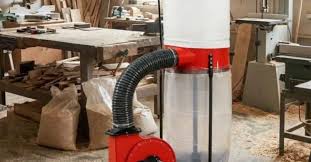
Woodworking facilities generate some of the highest dust volumes per square foot of any manufacturing environment. A 20-inch drum sander at full width generates 150–200 CFM of chip-laden air; a single CNC router cutting MDF produces fine particulate at concentrations that exceed OSHA’s 15 mg/m³ wood dust PEL within seconds of uncontrolled exposure. The cyclone dust collector has become the preferred primary collection technology in woodworking operations of all sizes — from professional cabinet shops to large-scale furniture manufacturers — for five documented, quantifiable reasons.
The cyclone separator uses centrifugal force rather than filter media to separate particles from the air stream, making it uniquely suited to the high-volume, coarse-to-medium particle size distribution characteristic of woodworking dust extraction applications.
Benefit 1: Near-Zero Filter Consumable Cost
The defining operational advantage of a cyclone dust collector is the absence of primary filter media. In a cyclone, the spinning airstream creates centrifugal forces 5–100× greater than gravity, throwing particles outward to the cyclone wall where they spiral down and collect in the hopper below — without touching any filter. For a woodworking shop processing 200–300 board feet per hour, a conventional cartridge collector might require cartridge replacements every 3–6 months at $180–$350 per cartridge (sets of 2–4), costing $1,400–$8,400 per year in filter media alone.
A cyclone handling the same volume as a pre-separator has zero primary filter media cost — the only consumable is a collection bag at the hopper discharge, costing $0.80–$2.00 each. Annual collection bag cost for a typical shop: $40–$120.
Benefit 2: Continuously Self-Clearing — No Downtime for Filter Cleaning
Baghouse and cartridge collectors require periodic filter cleaning (pulse-jet air blasts) or filter replacement to maintain airflow. This cleaning consumes compressed air (0.5–2.5 scfm per pulse) and creates brief periods of reduced collection efficiency during the cleaning cycle. A cyclone separator operates continuously without any cleaning requirement — collected material falls continuously into the hopper, and airflow resistance remains constant until the hopper fills. For woodworking dust extraction in production environments, this translates to uninterrupted extraction efficiency throughout the entire shift.
Benefit 3: High Collection Efficiency for Woodworking Particle Sizes
Woodworking operations generate a wide particle size distribution: large chips (500–5,000 µm) from ripping and surfacing, medium sawdust (50–500 µm) from circular saws and routers, and fine sanding dust (1–50 µm) from drum and orbital sanders. High-efficiency cyclone separators with inlet velocities of 3,000–4,500 FPM achieve collection efficiencies of 99%+ for particles above 20 µm — capturing virtually all the chip and sawdust fraction at zero filter media cost.
• Typical cyclone collection efficiency by particle size in woodworking:
• Chips and shavings (> 500 µm): 99.9% collection efficiency
• Coarse sawdust (50–500 µm): 98–99.5% collection efficiency
• Fine sanding dust (10–50 µm): 90–97% collection efficiency
• Very fine dust (< 10 µm): 50–80% collection efficiency — secondary filter required for compliance
| Cyclone Type | Cut Size (D50) | Efficiency > 10 µm | Best Woodworking Application | Pressure Drop |
| Standard single cyclone | 15–25 µm | 90–95% | Chip and sawdust primary collection | 1.5–3.0 in. w.c. |
| High-efficiency cyclone | 8–15 µm | 95–99% | Fine sanding dust pre-separation | 2.5–5.0 in. w.c. |
| Multi-clone (parallel array) | 5–10 µm | 97–99.5% | MDF/fine composite dust pre-sep. | 3.0–6.0 in. w.c. |
Benefit 4: Dramatically Extends Secondary Filter Life
When a cyclone separator is used as a pre-separator upstream of a baghouse or cartridge collector, it removes 85–99% of the incoming dust mass before the airstream reaches the downstream filter. The secondary filter sees only the fine fraction — typically 1–10% of the original dust loading by mass. In a documented case study, a furniture manufacturer in Wisconsin added a high-efficiency cyclone upstream of an existing cartridge collector handling MDF sanding dust. Pre-cyclone cartridge replacement interval: 6 weeks. Post-cyclone cartridge replacement interval: 14 months — a 10× extension in filter life that saved $22,400 per year in cartridge costs.
Benefit 5: Simple, Low-Maintenance Design with Long Service Life
A cyclone dust collector has no moving parts in the separation chamber — it is entirely static, relying on aerodynamic geometry to generate centrifugal separation. This mechanical simplicity translates directly to exceptional service life and low maintenance burden. A properly fabricated steel cyclone in woodworking service (handling non-abrasive wood dust) has a design life of 15–25 years with no scheduled maintenance other than hopper emptying and an annual visual inspection of welds and seals.
| Maintenance Item | Cyclone Separator | Cartridge Collector | Pulse-Jet Baghouse |
| Filter media replacement | None | Every 6–18 months | Every 18–36 months |
| Cleaning system maintenance | None | Pulse valve inspection annually | Solenoid valve, timer — annually |
| Compressed air consumption | Zero | 0.5–2.5 scfm continuous | 1.0–5.0 scfm continuous |
| Moving parts in airstream | None | None (static media) | None (static bags) |
| Typical service life | 15–25 years | 10–15 years (housing) | 12–20 years (housing) |