


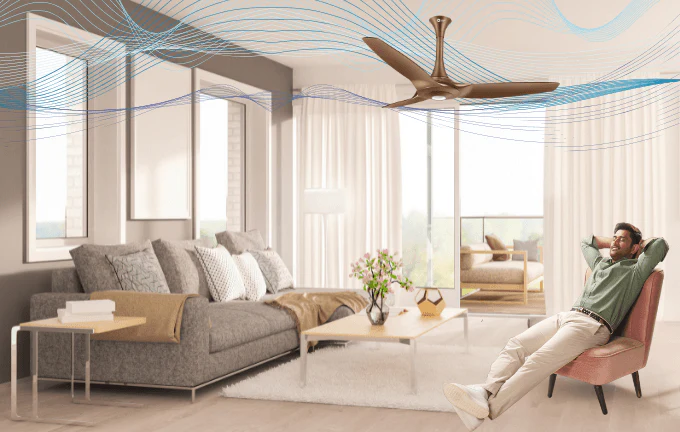
There’s a fan running in your living room right now. Probably has been since March. And if it’s more than four or five years old, it’s almost certainly a conventional induction motor, the kind that hasn’t meaningfully changed since your parents’ generation was furnishing their first home. That fan is costing you more than you’ve ever sat down to calculate. Not dramatically. Just quietly, consistently, month after month.
That’s actually the worst kind of expensive.
Wattage Is Where the Living Room Problem Starts
Conventional fans, and this covers the vast majority of what’s installed in Indian homes built before 2020, draw somewhere between 60 and 75 watts at full speed. One fan, fine. But a living room fan that runs from 8 am to 10 pm isn’t running eight hours. It’s running fourteen. Do the maths: 70 watts times 14 hours is just under one unit of electricity. Every single day.
Across 300 days, which is conservative for most of the country, that’s 294 units from one fan in one room. At ₹8 per unit, you’re spending roughly ₹2,350 a year on a single living room fan that nobody’s given a second thought to since the electrician fitted it. If you’ve been comparing living room ceiling fans as a replacement, that number is where the conversation should start.
Rooms above 200 square feet running two fans? Double it.
What a BLDC Motor Does That Your Current Fan Simply Can’t
BLDC is brushless direct current. The motor uses a permanent magnet rotor rather than the copper windings that conventional induction motors rely on, and that one difference changes everything about how efficiently it converts electricity into airflow. Less resistance, less heat, far less waste.
A good 5-star BLDC living room fan pulls between 28 and 35 watts. That’s it. Atomberg’s Renesa is probably the most recognisable BLDC fan in the Indian market right now, running at 28 watts. Orient’s Aeroquiet BLDC sits at 28 to 32 watts, depending on which variant you’re looking at. Both of them move air at CMM figures that match or beat conventional fans, consuming 65 to 70 watts.
Think about that for a second. Same airflow. Less than half the electricity.
Running a 28-watt fan for 14 hours a day over 300 days comes to around 117 units annually. Against 294 units from a conventional fan on the same schedule, that’s 177 units saved per year, per fan. At ₹8 a unit, you’re keeping roughly ₹1,416 in your pocket annually from one room. Two fans in a larger living space and that saving crosses ₹2,800 a year without you changing anything else about how you live.
The Numbers, Side by Side
One living room fan, 14 hours a day, 300 days a year:
| Fan Type | Wattage | Annual Units | Annual Cost (₹8/unit) |
| Conventional 3-star | 70W | 294 units | ₹2,352 |
| 5-star BLDC | 28W | 117 units | ₹940 |
| Annual saving | 177 units | ₹1,412 |
A decent 5-star BLDC living room fan costs between ₹2,500 and ₹3,500 today. Atomberg Renesa is around ₹2,799, and Orient Aeroquiet BLDC falls in a similar range. A conventional fan replacement runs ₹1,200 to ₹1,800. The payback on the price difference works out somewhere between 18 and 26 months, after which the BLDC fan is simply cheaper to run for however long it lasts, and BLDC motors routinely last 10 to 15 years.
There’s something else worth mentioning. At low speeds, conventional motors are genuinely inefficient; they hunt for torque, they hum, and they vibrate slightly at speeds 1 or 2. A BLDC motor doesn’t do any of that. It regulates cleanly at every setting. For a living room fan that spends most of its life at speed 2 or 3, this isn’t a minor point.
Before You Buy: Three Things That Actually Matter
Size first. A living room below 150 square feet can manage with a 48-inch fan. Between 150 and 220 square feet, go to 52 inches. Bigger than those two fans, placed centrally in each half of the room, will always beat one oversized unit trying to do a job it wasn’t designed for.
Then check wattage at full speed (35W or below is the threshold that earns the 5-star label under BEE’s revised 2023 framework), CMM output (210 or above for a 52-inch fan is the benchmark worth holding to), and whether the brand has service infrastructure in your city. A ₹3,000 fan with no local technician is a gamble most people don’t realise they’ve taken until something goes wrong.
Conclusion
A living room fan that runs all day, every day, for most of the year isn’t a background appliance; it’s one of the most active consumers of electricity in the home. The 5-star BLDC options available in 2026 are not marginally better than what came before. They use half the electricity, perform better at the speeds people actually use, and carry the purchase cost back within two years.
The conventional fan running in your living room right now isn’t broken. It’s just expensive. And that’s a fixable problem.